Feng Shui represents the traditional Chinese concept of man harmonizing with his environment. Oriental philosophy proposes that we are a microcosm of a macrocosm—our outer world being a reflection of our inner world—and vice versa. It suggests that our environment affects us more than we realize.
All matter has vibration—the Hindus call it Prana—the Hebrews call it Ruach— the Greeks call it Pneuma—the Japanese call it Ki and the Chinese call it Qi (pronounced Chee).
Qi roughly translates as the life force or cosmic breath which pervades all of life. It is the force of change and transformation that is believed to have created the landscapes of our planet. If we consider Qi to be a current of energy, when we are out of step with the natural flow, it is against this current that we struggle literally. Feng Shui is concerned with overcoming this struggle by harnessing supportive Qi via placement, design, element, color, and much more.
We all know that the impact the moon has on the tides of the ocean, which is an enormous body of water. Well, we are over 60% water, so what impact might the moon have on us? Less well known is the fact that some surgeons are cautious about performing surgery around the time of the full moon because of the impact on the flow of the blood in the body.
It would seem that mankind and the planet are much more connected than we realize.
Feng Shui is based on the principle of Yin and Yang. Balance, harmony, consistent change, and the interdependency of all things are but a few of the deep meanings within this simple representation. Yang representing heat and light is rising and Yin representing cold and darkness descends. These are just two of the many examples of logic and insight to be discovered within this image.
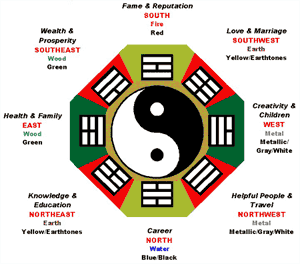
Shown above, the image represents the true orientation of the Yang and Yin. Yang, representing heat rises on the left (or East) and reaches its peak at the top (South). Yin representing coolness descends on the right (West) and reaches its maximum at the bottom (North).
Another analogy is that the sun rises in the East, reaches its hottest at noon and sets in the west, soon reaching its darkest. Yet within Yin there is a seed of Yang waiting to arise and within Yang there is Yin waiting to descend. This analogy can be applied to time, seasons, directions, and many other cycles of change.
The balance of yin and yang can be found both outdoors and indoors in the balance of shade and light, soft and hard, passive and active, and other polar qualities. Most people feel comfortable when their environment has this balance. The theme of the four seasons symbolizes the cyclical nature of human and plant life: spring = new life, summer = growth, autumn = harvest, and winter = death. Summer is the time of year when both crops and people develop at their fastest rate and reach their full potential.
Another simple, yet powerful representation based upon the Tai Chi (Yin and Yang representation shown above) is the 5 elements diagram. It is a view of how the elemental energies interact. Shown above in its balanced state, it is in harmony. Yet each element can strengthen or weaken other elements in a variety of beneficial and detrimental ways. When calculating the energy "blueprint" of a property these interactions provide the key to correcting issues within a property.
The Eight Trigrams are the basis for Feng Shui analysis and calculations. A Trigram is a representation of one of the eight directions. In the "Ba Gua" diagram below there is also a center which has no directional association, but is associated with earth. Based also on Yin and Yang concepts, the I-Ching, the Five Elements, and the Lo-shu map, it conveys a map for all other calculations used to determine the energy blueprint within a property.
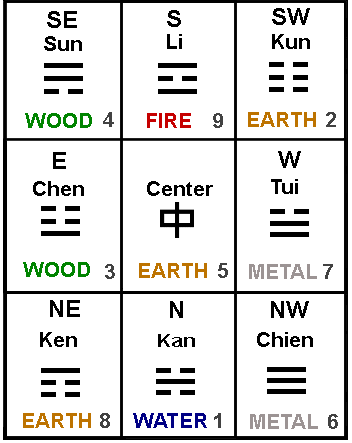
Both people and houses belong to one of the above Trigrams. Each of the Trigrams fall into two distinct categories as either east group or west group. You can determine a group by finding your lucky directions or "Ming Gua" from the tables below (with the exception of a 5 Gua person. For a lady who is a 5 Gua, we will look to the 8 Gua for her information. For a gentleman who has a 5 Gua, we are going to look to the 2 Gua for his information):
For your convenience, simply tell me your gender and birthdate in the chart below and I will help you find your group and your lucky directions.
| Gua 1 | 1914 - 1923 - 1932 - 1941 - 1950 - 1959 - 1968 - 1977 - 1986 - 1995 - 2004 - 2013 - 2022 |
| Gua 2 | 1915 - 1924 - 1933 - 1942 - 1951 - 1960 - 1969 - 1978 - 1987 - 1996 - 2005 - 2014 - 2023 |
| Gua 3 | 1916 - 1925 - 1934 - 1943 - 1952 - 1961 - 1970 - 1979 - 1988 - 1997 - 2006 - 2015 - 2024 |
| Gua 4 | 1917 - 1926 - 1935 - 1944 - 1953 - 1962 - 1971 - 1980 - 1989 - 1998 - 2007 - 2016 - 2025 |
| Gua 5 | 1918 - 1927 - 1936 - 1945 - 1954 - 1963 - 1972 - 1981 - 1990 - 1999 - 2008 - 2017 - 2026 |
| Gua 6 | 1919 - 1928 - 1937 - 1946 - 1955 - 1964 - 1973 - 1982 - 1991 - 2000 - 2009 - 2018 - 2027 |
| Gua 7 | 1920 - 1929 - 1938 - 1947 - 1956 - 1965 - 1974 - 1983 - 1992 - 2001 - 2010 - 2019 - 2028 |
| Gua 8 | 1921 - 1930 - 1939 - 1948 - 1957 - 1966 - 1975 - 1984 - 1993 - 2002 - 2011 - 2020 - 2029 |
| Gua 9 | 1922 - 1931 - 1940 - 1949 - 1958 - 1967 - 1976 - 1985 - 1994 - 2003 - 2012 - 2021 - 2030 |
| Gua 1 | 1918 - 1927 - 1936 - 1945 - 1954 - 1963 - 1972 - 1981 - 1990 - 1999 - 2008 - 2017 - 2026 |
| Gua 2 | 1917 - 1926 - 1935 - 1944 - 1953 - 1962 - 1971 - 1980 - 1989 - 1998 - 2007 - 2016 - 2025 |
| Gua 3 | 1916 - 1925 - 1934 - 1943 - 1952 - 1961 - 1970 - 1979 - 1988 - 1997 - 2006 - 2015 - 2024 |
| Gua 4 | 1915 - 1924 - 1933 - 1942 - 1951 - 1960 - 1969 - 1978 - 1987 - 1996 - 2005 - 2014 - 2023 |
| Gua 5 | 1914 - 1923 - 1932 - 1941 - 1950 - 1959 - 1968 - 1977 - 1986 - 1995 - 2004 - 2013 - 2022 |
| Gua 6 | 1913 - 1922 - 1931 - 1940 - 1949 - 1958 - 1967 - 1976 - 1985 - 1994 - 2003 - 2012 - 2021 |
| Gua 7 | 1912 - 1921 - 1930 - 1939 - 1948 - 1957 - 1966 - 1975 - 1984 - 1993 - 2002 - 2011 - 2020 |
| Gua 8 | 1911 - 1920 - 1929 - 1938 - 1947 - 1956 - 1965 - 1974 - 1983 - 1992 - 2001 - 2010 - 2019 |
| Gua 9 | 1910 - 1919 - 1928 - 1937 - 1946 - 1955 - 1964 - 1973 - 1982 - 1991 - 2000 - 2009 - 2018 |
You now can then determine which of the eight magnetic directions are beneficial and which are detrimental to your well-being. You can determine which direction is best for work, study, and sleep. You will also understand how you affect and are affected by other people.
There are eight types of qi collectively known as the Eight Wandering Stars (You Xing). Referring to the following table, I have included each star's Chinese name and English translation, a level of fortune, and a description of its qi. The letter F stands for Fortunate Qi, with F1 being the most favorable star and F4 being the fourth most favorable star. Conversely, the letter H stands for Harmful Qi, with H1 representing the least harmful star and H4 the most harmful star. Depending on which trigram you belong, each of the eight directions is either fortunate or harmful to you in varying degrees. With "F1" being your most positive direction to face, and "H4" being your worst direction to face. It is color coded for you so that your positive directions are appearing in Green, and your adverse directions are indicated in Red.
| Personal Trigram | Favorable Directions | Harmful Directions | |||||||
|
Gua Number |
Group |
F1 Vitality |
F2 Love |
F3 Health |
F4 Peace |
H1 Mishaps |
H2 Six Devils |
H3 Five Ghosts |
H4 Death |
| 1 | East | SE | S | E | N | W | NW | NE | SW |
| 2 | West | NE | NW | W | SW | E | S | SE | N |
| 3 | East | S | SE | N | E | SW | NE | NW | W |
| 4 | East | N | E | S | SE | NW | W | SW | NE |
| 5 Male | West | NE | NW | W | SW | E | S | SE | N |
| 5 Female | West | SW | W | NW | NE | S | E | N | SE |
| 6 | West | W | SW | NE | NW | SE | N | E | S |
| 7 | West | NW | NE | SW | W | N | SE | S | E |
| 8 | West | SW | W | NW | NE | S | E | N | SE |
| 9 | East | E | N | SE | S | NE | SW | W | NW |
Your F1 direction corresponds to Sheng Qi, the auspicious qi energy that brings about heightened prosperity and respectability. It's your most favorable magnetic direction for conducting business, studying, or anything else importance. The element of this energy is wood.
Your F2 direction corresponds to Yan Nian, the qi energy that brings about longevity and romantic relationships. This direction is your second most favorable direction. The element of this energy is metal.
Your F3 direction corresponds to Tian Yi, the qi energy that brings about good health and harmonious relationships. This direction is your third most favorable direction.
Your F4 direction corresponds to Fu Wei, the qi energy that brings about peace and stability. It is your 4 th most favorable direction. You'll get the best sleep if your head points toward this direction.
Your H1 direction corresponds to Hou Hai, the qi energy that is considered the first least harmful. If located at your entrance or bedroom, Hou Hai qi has been known to cause accidents, arguments, and injury.
Your H2 direction corresponds to Liu Sha, the qi energy that is considered the second least harmful. Liu Sha qi has been known to cause malicious encounters or sexual entanglement and failed relationships.
Your H3 direction corresponds to Wu Gui, the qi energy that is considered the third most harmful . Wu Gui qi has been known to cause fires, accidents and abandonment of friends & family.
Your H4 direction corresponds to Jue Ming, the qi energy that is the most harmful and dangerous. You should spend the least amount of time in or avoid this area altogether. Jue Ming qi brings about disease, robberies, misfortune, and unproductive careers. Using entrances or bedrooms with Jue Ming qi will weaken your health, wealth, and relationships.
Did you observe that Gua's 1, 3, 4 and 9 all share positive directions to the North, East, SE & South; and that their negative directions come from the NE, SW, West & NW? Did you notice that Gua's 2, 6, 7 and 8 all share positive directions to the NE, SW, West & NW; and that their negative directions come from the North, East, SE & South. From these above observations we can ascertain that we are going to be either of the following group types:
The environmental aspects are what most people immediately think of when they consider Feng Shui. Things such as not having sharp corners pointed at them and not living under high tension power lines are a couple of common examples that everyone either knows or can understand. Other environmental aspects such as living next to a freeway or a construction site are considered unfavorable. The elimination of "Sha" or evil influences and strengthening those environmental aspects that are good is what an environmental analysis recommends. These are but a few examples of what needs to be examined during an analysis.
Call or e-mail me today and I can share with you how to apply Feng Shui principals to transform your life, work and home.